Posts

Guitar and the Bobcat
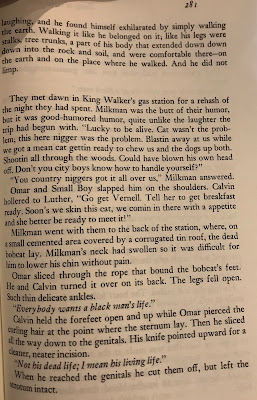
Image
In Toni Morrison’s Song of Solomon , Milkman goes on a long journey to find the gold that Macon and Pilate once possessed when their father passed away. Said journey leads Milkman to the town of Shalimar, where he goes hunting with some of the village men; they end up capturing a bobcat, which holds great significance to Milkman upon deeper analyzation. In the scene pictured below, Milkman watches as the men clean the cat.                             Here, the readers observe a change in Morrison’s style of writing. The narration plays back and forth between Milkman’s flashback to him and Guitar’s conversation – written in bolder, italicized font – and what he sees happening in front of him. In the parts that describe the scene in front of Milkman, Morrison uses language such as, “pierced the curling hair,” “tore like gossamer,” and “carved out the r...

Dr. Foster

Image
So far in Toni Morrison’s Song of Solomon , we don’t know much about Doctor Foster, aside from the descriptions of him that each character provides. Today, I wanted to analyze the first detailed description the readers get of him, through Macon Dead’s eyes as he has a talk with Milkman after Milkman hits his father (page 71, pictured below).   The first thing that stood out to me while reading this excerpt was the fact that while Dr. Foster was delivering Ruth’s two children, “each time all he was interested in was the color of their skin,” even though he was a colored man himself (Morrison 71). This implies that the doctor favors lighter skin and is racist towards his own culture, his own people, and Macon Dead even tells Milkman, “He would have disowned you” (Morrison 71). Thus, this justifies Macon Dead’s statement that “a bigger hypocrite never lived” (Morrison 71). The audience also learns for the first time that Dr. Foster was addicted to a drug called ether,...

Chance - Song of Solomon

Image
Recently I began reading the novel Song of Solomon by Toni Morrison, and let me just say… this book is a Six Flags rollercoaster ride in and of itself! Morrison depicts the struggles of the African American community using rather unorthodox topics, such as incest, and discusses their disparities through subtle comments by the characters that hold deeper meanings. One particular instance that stood out to me is the discussion between Pilate’s family, Guitar, and Milkman in Chapter 2, in which the reader learns the origins of Guitar’s name and Reba’s secret luck. Guitar’s name comes from the fact that he wanted to win a guitar when he was younger so he could learn how to play. However, the only way he could win that guitar was by guessing the correct number of jellybeans in the glass jar. Thus, whether or not he would win depended solely on chance. Reba tells Guitar, “I win everything I try to win and lots of things I don’t even try to win,” and recalls the story of how she wo...

Feminist Criticism - The Great Gatsby

Image
The Great Gatsby is a classic, timeless piece of American literature that depicts what life was like in the nineteen twenties, and carries with it a number of important themes. Fitzgerald was known for writing about love and The American Dream. However, it requires further examination, especially through the feminist lens, in order to understand how Fitzgerald crafted the women in his novel/his intentions.   In this piece, Fitzgerald describes the female characters in unsympathetic ways that make them seem like vulgar, annoying liars. Jordan Baker, a jaunty golfer, is known for having covered up a cheating scandal during one of her tournaments that almost surfaced to the public if she hadn’t made some payments to hush those involved. Myrtle Wilson’s overt sexuality and “unladylike” behavior, such as her immodest apparel, public drinking, and extramarital affair, cause her to be the representation of the vulgarity of the New Woman, which is confirmed in her comment abou...

Fashion in the 1920s

Image
The Roaring Twenties was a time of elaborate partying, heavy drinking, and glamorous attire. In the novel The Great Gatsby by F. Scott Fitzgerald, taking place in the 1920s time period, the lavish lifestyles of Jay Gatsby and those around him are reflected by the clothing they wear. Nick Carraway, the main protagonist, describes an instance in which Gatsby is dressed in “a white flannel suit, silver shirt, and gold-colored tie” (84). The color white was often symbolic of class during the Jazz Age, and many wealthy people donned cars and clothing in this shade, as illustrated in the novel.   Women’s fashion during the Jazz Age was all about breaking tradition. They ditched their corsets and frilly dresses and opted for more shapeless, shorter articles of clothing that allowed them to freely move and dance. They also began to wear colorful fabrics and cut their hair very short – the ‘bob’ style originated during this time period. In addition, sportswear for women was very po...

Nazi Propaganda and Maus

Image
    In the graphic novel Maus by Art Spiegelman, the author uses the images featured in each chapter title to resemble, in one way or another, forms of Nazi propaganda. In this Nazi poster, there are many similarities and differences apparent between it and Spiegelman’s artwork on the Chapter Two title page in volume one that convey a deeper meaning. The poster features a Nazi soldier standing in front of a large Nazi flag accompanied by what appears to be ordinary Germans standing behind him. It is important to note that the soldier is facing away from the flag, with it supporting him from behind. This represents the Nazis leading the German citizens towards the ways of Hitler’s anti-Semitism. They are the driving force of the war, with the flag being a supportive emblem of their work. The flag itself is symbolic of the concept “Death to the Jews!” with the Nazis carrying out the deed. By contrast, Spiegelman’s work shows a group of mice, which represent th...

The Holocaust, Other Than Representation

Image
“To attempt to represent Auschwitz in language – to reduce the degradation, death, and stench to a concept – drowns out the screams…it is therefore necessary that the Holocaust remains immemorial – that it remains that which cannot be remembered – but also that which cannot be forgotten. Thus, any art attempting to represent the Holocaust should continue to haunt us with its inability to represent the unrepresentable, to say the unsayable. It should continue to haunt us with the feeling that there is something Other than representation.” – Jim Powell, Postmodernism for Beginners   Reading this quote from Jim Powell’s novel, I agree with the point he makes. The Holocaust is inarguably the most abhorrent and inhumane event to occur in history, and thus cannot simply be composed into a series of pages. The genocide of millions of Jews across Europe, and the torture they endured leading up to their murders, are unfathomable to those who did not witness this nightmare.   ...