Posts

Barbie Reflection

Image
Growing up as a kid, I adored my Barbies. I bought them clothes and houses and little mini-pools. I lived in Barbie’s world. But as I progressed through my youth, I became envious of her long blonde hair and blue eyes. I began to understand the implications Barbie has on the real world – how she misrepresents women and serves as the unrealistic beauty ideal.   As Emily Prager puts it, “there are millions of women who are subliminally sure that a thirty-nine-inch bust and a twenty-three-inch waist are the epitome of lovability.” So much emphasis placed on this little piece of plastic. But people don’t see her as simply a piece of plastic – she is viewed as so much more. Mattel constantly updates and refurbishes Barbie’s appearance, releasing new dolls that each represent something. Pictured below is the evolution of Barbie’s looks as she is changed to fit the “in,” popular style of the time period.   After the great debate and heavy criticism regarding Barbie...

The Quest for Aliens

Image
  As Chet Raymo asserts, mankind as a whole must engage in a sort of “integrity and balance within nature that demands of earth’s dominant species a judicious self-restraint.” This type of equilibrium is crucial, Raymo continues, as the “unexamined quest for knowledge is hemmed with peril.” Now, the first thing I thought of with all this heavy emphasis on restraint in regards to knowledge was aliens. Yes, aliens. With everything we see in the media nowadays, or the lack thereof, I’m reluctant to believe that aliens actually exist. However, with all the covert operations and research occurring in areas such as the notorious Area 51, or even in the conference rooms of the FBI, there’s definitely more pieces to the puzzle than we know. In our quest to discover the truth about aliens, I feel as though mankind is sort of screwing with the world’s mojo. I mean just as Raymo made a whole point of saying, some things are truly better left untouched. There can be real...

Artifice in Politics

Image
According to Chris Hedges, artifice is “the most essential skill” for political leaders. I strongly agree with hedges assertion, as artifice is a crucial asset one must employ in order to craft a trustworthy persona and thus guarantee political victories. In the most recent presidential election, Donald Trump effectively utilized artifice to win over the hearts of the A merican people. Claiming that he is an ordinary American, completely disregarding his billionaire status, Trump developed a believable “story, a personal narrative.” People viewed him as someone they could relate to – a candidate with almost no political ties or experience. This form of pathos heavily appealed to peoples’ emotions, igniting powerful feelings of patriotism. Using this to his advantage, Trump was able to meticulously craft stories and statistics that were “completely at odds with the facts,” which he still does to this very day. He upholds his “typical American man” persona, addressing the crow...

English as the Official Language?

Image
  America is known worldwide for being a nation rich with diversity, in which peoples’ natural rights like free speech and religion are concretely confirmed in the law of the land. Unlike many other countries across the globe, America does not have an official language. In Charles Krauthammer’s words, “The Senate could not bring itself to declare English the country’s ‘official language.’ The best it could do was pass an amendment to the immigration bill tepidly declaring English the ‘national language.’” Krauthammer’s position on this topic is clearly demonstrated by his tone – he wants more, he wants ~ official~ . I’d have to say I disagree with him. The United States encompasses not only our 50 states, but also the territories we have, including Puerto Rico and Guam. To make English the official language is a careless and mindless act against these people, whose main language and patrimony center around the Latin origin. We would be eradicating their culture. Fur...

The Arabic Language

Image
  My family is from the northern region of Africa – a small country at the tip of the continent named Tunisia. The primary languages spoken there are Arabic and French, so naturally that’s what I grew up speaking, and thus language plays a huge role in my life. Pinker describes the importance of language as ”a social currency with real value,” and I couldn’t agree more with him, as language allows us to barter our thoughts and express our emotions in unique ways. Arabic is an important part of my life, as it allows me to communicate with my family members overseas and other people across the world. It encompasses its own alphabet, much like the Persian alphabet, and unlike most other languages, we write from right to left.   Not only is it a language, but it’s a way of living, with its own customs and sayings and habits. What I love most about Arabic is the idioms and expressions that are often used and extremely hard to translate. These old and often used sa...

My Realization

Image
Just as Virginia Wolf’s recollection of the moth’s death “roused [her]” and a great realization “flashed upon [her],” I too experienced a change in mindset when a peer, Danny Ashtiani, passed away. Although I wasn’t that close to Danny, his passing revealed something to me that I only ever realized then – people are so evil and tend to care when it’s too late. At his funeral, I noticed people there who used to bully him, call him weird and strange, his friends and family, complete strangers from around town, etc… even this one girl who screamed at him in front of everyone at a football game for something he didn’t do, and then noticeably made his life a living hell for about a week or two. All these people, just suddenly now caring about this boy and mental health, most of them fully aware about his struggle to cope… I hated it, and I didn’t know how prevalent this carelessness actually was. Perfect hypocrisy scenario. Then came the post-passing events: the school’s effort (o...

Dumspter Diving & Self Reliance

Image
After reading “On Dumpster Diving” by Lars Eighner and glancing over the analysis questions that followed, one in particular really stood out to me. Eighner states, “I think of scavenging as a modern form of self-reliance.” Is there truly irony behind this statement? Like many others who read the piece, initially I thought, “Psshh yeah right, how is it self-reliance if you’re relying on other people’s garbage? Preposterous.” How could someone who clearly does not rely on himself make the claim that this art he engages in is essentially all about relying on himself? It didn’t make sense; of course it HAD to be ironic, so that was the stance I took. However, after further thinking about this, I believe it really all comes down to what lens you view his statement in. For Eighner and many other serious dumpster divers, who have close to nothing, this craft truly is self-reliance to them. They can only count on themselves to go and scavenge for their means of living – in fact ...

Touring, According to Wallace

Image
In David Foster Wallace’s piece, “Consider the Lobster,” he makes a rather bold statement:   “To be a mass tourist, for me, is to become a pure late-date American: alien, ignorant, greedy for something you cannot ever have, disappointed in a way you can never admit…It is to impose yourself on places that in all non-economic ways would be better, realer, without you.”   As an avid traveler, I tend to disagree with Wallace’s point of view.   His statement appears to be one of subjectivity; I mean depending on who you are/where you’ve been, your opinion could vary widely . I have spent a good portion of my life touring cities around the world, and never once have I felt “greedy for something [I] cannot ever have.” In fact, I feel quite the opposite. Every time I visit a new part of the world, I feel so thankful and blessed to experience such a journey – trying local foods, seeing the beautiful scenery, exploring ancient areas, meeting new people, etc. I don’t feel as...

Puzzle P1 - "I Want a Wife"

Image
This was me when I first read Brandy's piece Once upon a time , deep in the world’s profound abysses, there existed a society where women were viewed and valued as the utmost powerful human beings. Everyone respected females and no one dared mess with them. Women were entitled to their own personal husband(s) – someone who cooked, cleaned, managed the children he supplied (only if the women wanted them of course), took care of the family schedule, and that of the like. My god, who wouldn’t want a husband?     This sadly fictitious nation exemplifies a norm that is the exact opposite of the way gender roles work today . In fact, the current demanding nature of men in society is perfectly illustrated through Judy Brandy’s rhetoric in her piece, “I Want a Wife.”   Brandy states she wants a wife who : “arrange[s] to lose time at work…and pay for the care of the children,” will “do the cleaning up while [Brandy does her] studying”, “is sensitive to [Brandy’s] sexual...

Clothing & Gender: Marked vs. Unmarked

Image
Deborah Tannen claims that “there is no unmarked woman,” and that men, unlike women, have “the option of being unmarked.” I’ve been thinking about Tannen’s words lately and I can surely say I agree with her wholeheartedly. When walking down the street, or in the halls at school, most people can say that they pay more attention to women than men. Women’s fashion tends to stand out more than men’s. Honestly, women make a statement about themselves no matter what they wear – assumptions are automatically made about them based on their appearance and they can further be classified. I mean, we even have stereotypical names like “the basic white girl” for females, but why isn’t their “the basic white guy” for males’ appearance? Men can choose whether or not they are marked. They can choose to wear everyday ordinary clothes like sweats, jeans, plain shirts, etc. or business attire like a suit, slacks, etc. Most of the time, people don’t think twice when they see a male in passing,...

Real-Time Racial Profiling

Image
On a recent trip to my local Kroger, I witnessed an event that not only surprised me, but it also left me thinking hard. What better time to share this story than now - considering the fact that it fits perfectly into what we have been discussing in my English class lately. As Brent Staples puts it, I witnessed a human being’s ability to “alter public space in ugly ways.”                 I was waiting in line at the self-checkout area one night and a young African American male was standing in front of me. He fit the stereotypical description of a black man from Detroit – saggy pants, a hoodie, boots, the whole look. Needless to say, he seemed a little out of place in a predominantly white area (Troy). I didn’t notice this at first until after the incident. He seemed to me like any tired person just waiting to pay for their groceries and go home to their family. However, I started to realize people stari...

Lacking Disability in the Media

Image
It’s common fact that disability is hardly ever depicted in the media today. When was the last time you saw a model with missing limbs strutting down the runway? A person in a wheel chair featured on the cover of a well-known magazine? As Nancy Mairs, who battles MS, puts it, “I haven’t noticed any women like me on television.” What I’m really wondering is why? Why does the media chose, purposely, to exclude this minority – the ONLY minority we can and will involuntarily join by the way? It’s wrong and it’s shameful; these are ordinary human beings who have suffered extraordinary circumstances and are still here today trying to live their most normal lives. We should work to do the opposite, to empower them rather than isolate them. I did some of my own research to see if there was some progress being made, and I was actually surprised by what I found. Below are some major companies, such as Nike and Target, who feature disability in their advertisements. I especially love Tar...

Underappreciating Nature

Image
Nature to me is one of the loveliest assets of this life. Being able to wake up every morning to a rising sun on the horizon is a real blessing – a blessing that most people seem to look past. Instead of admiring and appreciating nature’s work, nowadays all society does is complain. As Joyce Williams said, “You don’t believe in Nature anymore. It’s too isolated from you. It’s so messy and damaged and sad.” Really, we just view nature as an inconvenience in our day to day lives. Upon walking into school this time of the year, I hear incessant grumbles of, “I hate winter, I hate driving in the snow!” “It’s too cold for this #&%$” Well, maybe drive way slower than you normally would? Maybe leave your house a couple minutes earlier in the morning? Maybe bundle up and wear an extra layer or two? … just some suggestions. Simply put, STOP BLAMING NATURE! We blame nature for certain things when really we should be blaming ourselves. For instance, it’s not nature’s fault that y...

Satire Analysis - Gun Control

Image
Carol Elsen, in her graphic organizer called the “Ironometer,” defines satire as “fine raillery or ‘corrective ridicule.'”                                                                                                   Upon first glance, this satirical cartoon makes fun of the fact that people across the nation, specifically parents, view the lack of gun control as the problem that leads to major shootings, such as school massacres. However, not only do they blame lack of gun control, but they also do noth...

Guitar and the Bobcat

Image
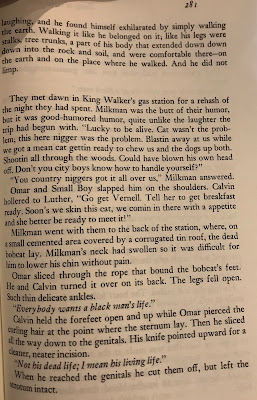
In Toni Morrison’s Song of Solomon , Milkman goes on a long journey to find the gold that Macon and Pilate once possessed when their father passed away. Said journey leads Milkman to the town of Shalimar, where he goes hunting with some of the village men; they end up capturing a bobcat, which holds great significance to Milkman upon deeper analyzation. In the scene pictured below, Milkman watches as the men clean the cat.                             Here, the readers observe a change in Morrison’s style of writing. The narration plays back and forth between Milkman’s flashback to him and Guitar’s conversation – written in bolder, italicized font – and what he sees happening in front of him. In the parts that describe the scene in front of Milkman, Morrison uses language such as, “pierced the curling hair,” “tore like gossamer,” and “carved out the r...

Dr. Foster

Image
So far in Toni Morrison’s Song of Solomon , we don’t know much about Doctor Foster, aside from the descriptions of him that each character provides. Today, I wanted to analyze the first detailed description the readers get of him, through Macon Dead’s eyes as he has a talk with Milkman after Milkman hits his father (page 71, pictured below).   The first thing that stood out to me while reading this excerpt was the fact that while Dr. Foster was delivering Ruth’s two children, “each time all he was interested in was the color of their skin,” even though he was a colored man himself (Morrison 71). This implies that the doctor favors lighter skin and is racist towards his own culture, his own people, and Macon Dead even tells Milkman, “He would have disowned you” (Morrison 71). Thus, this justifies Macon Dead’s statement that “a bigger hypocrite never lived” (Morrison 71). The audience also learns for the first time that Dr. Foster was addicted to a drug called ether,...

Chance - Song of Solomon

Image
Recently I began reading the novel Song of Solomon by Toni Morrison, and let me just say… this book is a Six Flags rollercoaster ride in and of itself! Morrison depicts the struggles of the African American community using rather unorthodox topics, such as incest, and discusses their disparities through subtle comments by the characters that hold deeper meanings. One particular instance that stood out to me is the discussion between Pilate’s family, Guitar, and Milkman in Chapter 2, in which the reader learns the origins of Guitar’s name and Reba’s secret luck. Guitar’s name comes from the fact that he wanted to win a guitar when he was younger so he could learn how to play. However, the only way he could win that guitar was by guessing the correct number of jellybeans in the glass jar. Thus, whether or not he would win depended solely on chance. Reba tells Guitar, “I win everything I try to win and lots of things I don’t even try to win,” and recalls the story of how she wo...

Feminist Criticism - The Great Gatsby

Image
The Great Gatsby is a classic, timeless piece of American literature that depicts what life was like in the nineteen twenties, and carries with it a number of important themes. Fitzgerald was known for writing about love and The American Dream. However, it requires further examination, especially through the feminist lens, in order to understand how Fitzgerald crafted the women in his novel/his intentions.   In this piece, Fitzgerald describes the female characters in unsympathetic ways that make them seem like vulgar, annoying liars. Jordan Baker, a jaunty golfer, is known for having covered up a cheating scandal during one of her tournaments that almost surfaced to the public if she hadn’t made some payments to hush those involved. Myrtle Wilson’s overt sexuality and “unladylike” behavior, such as her immodest apparel, public drinking, and extramarital affair, cause her to be the representation of the vulgarity of the New Woman, which is confirmed in her comment abou...

Fashion in the 1920s

Image
The Roaring Twenties was a time of elaborate partying, heavy drinking, and glamorous attire. In the novel The Great Gatsby by F. Scott Fitzgerald, taking place in the 1920s time period, the lavish lifestyles of Jay Gatsby and those around him are reflected by the clothing they wear. Nick Carraway, the main protagonist, describes an instance in which Gatsby is dressed in “a white flannel suit, silver shirt, and gold-colored tie” (84). The color white was often symbolic of class during the Jazz Age, and many wealthy people donned cars and clothing in this shade, as illustrated in the novel.   Women’s fashion during the Jazz Age was all about breaking tradition. They ditched their corsets and frilly dresses and opted for more shapeless, shorter articles of clothing that allowed them to freely move and dance. They also began to wear colorful fabrics and cut their hair very short – the ‘bob’ style originated during this time period. In addition, sportswear for women was very po...